There are over 460 volunteer men and women who are well trained and prepared
to serve the DuBois community in times of fire, flood, or emergency.
City of DuBois Fire Department Web Site
http://www.duboispa.gov/departments/fire/index.html
We Thank Our Area Firefighters & Salute Firefighters Everywhere
Fireman are special people: Read: The Littlest Fireman
http://www.just4kidsmagazine.com/insp/firemanbilly.html
FIRE & FLOODS
Photos appear at the end of the articles
This article appears here with the permission of the author who retains exclusive and full ownership rights.
It is also fully protected by this website's copyright and may NOT be copied, printed or transmitted without written permission
THE GREAT DUBOIS FIRE - JUNE 18, 1888
By Gene Aravich
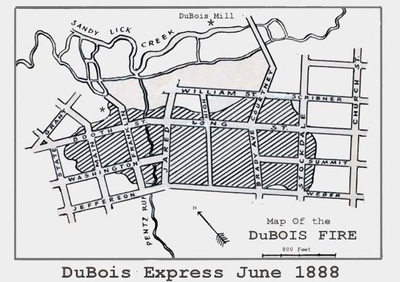
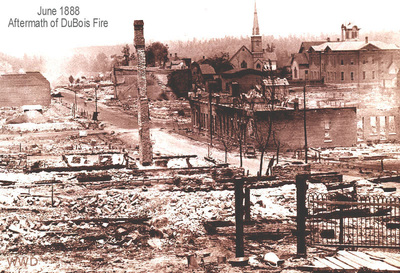
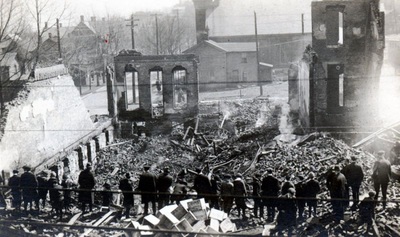
June 18, 1888: The alarm sounded at 2 o'clock in the afternoon. Smoke was seen coming from the Baker House, a three story building on North Franklin Street, and no more than 200 feet from the corner of West Long Avenue. At the time, the main part of town from Sugar Alley to Stockdale Street was almost all wooden buildings.
Roofs were hot from the sun and the wind was picking up and changing directions, spreading the fire in all directions. Flames leapt from building to building. The fire department was limited by lack of water. The water at Baker House was turned off and the initial flame dousing was done with buckets of water from nearby buildings. A water line was broken.
Residents hauled outside their possessions in attempts to save them. Some thought that the brick buildings would be safe but the intense heat melted off iron shutters and ignited the buildingÕs insides. When the fire reached Pentz Run, two buildings were dynamited to clear a stop the fire. By the time of the explosion, the buildings had already caught fire. The explosion blew the burning pieces out, spreading the fire.
John E. DuBois was seen with an axe, knocking barrels of whiskey rolled out to the streets from nearby saloons that were in the fireÕs path. He realized the problems that would result if the men began drinking. DuBois told the proprietor to bill him for the whiskey. Further down the street, some local men were spotted lying on the ground, drinking the spilling whiskey from the gutter.
Fire neared the First National Bank building. Bags of money and securities, boxes and baskets of legal papers were carried to the vault of the Deposit Bank to its fireproof vault.
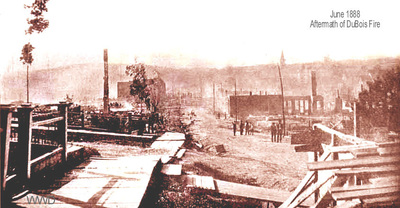
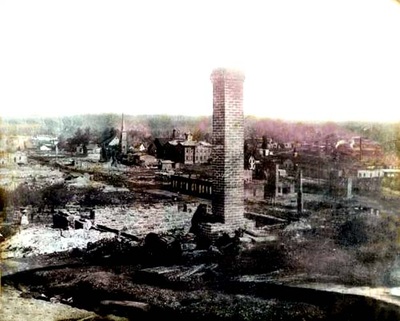
John E. DuBois telegraphed to Renova for a fire engine. When the fire started, there were 166 businesses in the city. At 6 p.m. that evening, only six were left. Nearly 500 people were homeless.
The state sent military tents. Nearby towns sent food, cash and supplies. John E. DuBois opened his store for the victims and advanced credit at the Company store. A committee from Philadelphia visited to see if assistance should be given for rebuilding. They reported that DuBois was nothing more than a fairly recent lumber town.
The banks found temporary locations to reopen. Insurance money arrived. With that, the town began to revive. Land owners found their property lines and began clearing and rebuilding. New building codes were enacted, requiring brick and stone construction rather than wood.
A new water system was discussed, along with sewers. In 1889, the city contracted with the United States Water Company, later forming DuBois City Water Works Company. Water was supplied from a reservoir located within 6 miles of Treasure Lake. Work began on the Anderson Creek Reservoir with a tunnel through the continental divide.
Within days after the fire, the Volunteer Hose Company No. 1 was formed. Others followed in other parts of the town. With fire companies spread out, buildings built with stone rather than wood, and the water supply being increased, DuBois made sure another "great fire" would not happen.
Firemens' Parade
The annual Firemen’s Parade is now in its third century, celebrating the volunteer firemen who keep the residents safe from the type of fires that devastated the city back in 1888.
In June of 1890, firemen lined up for a parade in downtown DuBois. Shortly after seven p.m., the whistle blew, signaling the start of the parade.
Every year since, the firemen’s parade tradition continues. Firemen from all over the area proceed through the town as the rest of the community applauds their service.
High school bands march along to entertain the crowds with their music. Main roads of the city are blocked off to allow the parade to pass by without pause. Dads, husbands and big brothers wave to their families from the back of their fire and rescue trucks which shine from days of polishing and waxing.
The City of DuBois realizes the important role that fire fighters play in the safety of their homes and businesses. The firemen’s parade is a chance for the entire community to show its appreciation to these courageous men.
THE MAJOR FLOODS
By Gene Aravich
This article appears here with the permission of the author who retains exclusive and full ownership rights. It is also fully protected by this website's copyright and may NOT be copied, printed or transmitted without written permission
Saint Patrick’s Day Flood, 1936
In the spring of 1936, several days of rain, combined with melting snow from a heavy winte,r caused the Saint Patrick’s Day flood that year.
Unable to handle the runoff, the Sandy Lick Creek overflowed and soon the city flooded. Liberty Boulevard at the time was several feet lower than it is now. The boulevard was covered with more than four feet of water from the Sandy Lick and Beaver Run. Traffic movement was impossible except for some high-bodied trucks. Travelers were trapped for several days in whatever town they happened to be passing through when the waters rose.
Water rose to its highest point during the flood with overflowing streams adding water to the dam. At the local reservoir, it was reported that the waters were rising more than six inches per hour. Forty-two inches of water poured over the spillway. The flood washed out Parker Dam.
The Meadowland area consisted of land between Main Street and the DuBois Mall. The waters turned it temporarily into a lake. The sanctuaries of many birds and animals that lived in the Meadows were flooded. Small animals such as chipmunks and rabbits were seen clinging to tree stumps and other floating debris. The flood severely hurt the local pheasant population.
When the water was rising residents attempted to move to the second floors of their homes, carrying furniture and rugs to safety. Businesses were hit hard. Stores in the lower sections of the city received more than a foot of water. Store owners used flash boards at the entrances to block water, but passing vehicles caused waves of dirty water to overflow the boards. Flood losses were high at the time, estimated at over two thousand dollars.
DuBois schools were also damaged by the flood waters. Classes were cancelled for almost a week while damage was being assessed. The basement of the high school, then located on Liberty Boulevard, was flooded. Nearly seven feet of water covered the floor the old gymnasium, which was located below the level of the basement classrooms. The floor ripped from its mounting and floated to within a few feet of the ceiling.
Chance of flooding was reduced over the years once five feet of landfill was added to the Boulevard and Meadowlands area. A flood control program in the seventies prevented a recurrence of severe flooding, allowing the Industrial Park to be built and to expand over the years.
Hurricane Agnes Flood, 1972
Through the years, DuBois has experienced some very costly floods. For local residents, this was a way of life. The entire area known as Beaver Meadow, the Boulevard, and other low-lying areas of the city were usually under water each spring.
During the days leading up the flood, Hurricane Agnes crept up the Atlantic coast, twice being down-graded into a tropical storm and then returning again to hurricane status. On Wednesday, June 22nd, relatively light rain fell on the area.
The next day, Agnes struck. During most of the day, Agnes moved northward along the eastern seaboard, dumping heavy rains over eastern PA. Late Thursday the 23rd, at 9 p.m., the U.S. Weather Bureau Hurricane Center in Boston showed Agnes moving northward on a path that would take it up the Hudson River Valley into New York.
But between 9 and 11 p.m., Agnes turned west and centered itself over DuBois. From then until noon on Friday, Agnes dumped rain on eastern Ohio, western Pennsylvania, northern West Virginia and southwestern New York, with an average of 8 ½ inches of rain reported over most areas. Five states, including hardest hit Pennsylvania, were declared federal disaster areas. Agnes, which formed in the Gulf of Mexico, became the costliest natural disaster in the U.S. at the time. Pennsylvania was brutalized by the storm, with $2.1 billion in damage and 48 deaths.
Sandy Lick Creek, the area for which DuBois had been trying to get aid for a flood control project, was the culprit responsible for flooding DuBois. Affected were the "flats" behind the current Hoss’s Steak n' Sea House on Liberty Boulevard and a large part of the West Long Avenue business district. Virtually every home in the flats was extensively damaged by water.
Water spilled over stream banks with little warning and flooded low areas. Residents and merchants had no time to move their belongings and merchandise to higher ground. Along Liberty Boulevard, over four feet of water covered the road from the Meadow, creating a lake that washed through the American Legion, John B. Green Oil Company, Way Field, the JayCee Pool, A&P Market, Continental Trailways Terminal, DuBrook, the Muter Company, DuBois Tastee Freeze, VFW Teener Field, Rockwell Manufacturing Plant and storage buildings, Pennsylvania Electric Co. offices, DuBois Business College, Foodland Market, Otocsin Motel and others.
The downtown district was under approximately five feet of water, damaging many businesses. Some of these were Kruk Floor Co., V.F.W., Warner’s Men’s Store, Shankel’s Pharmacy, Pennsylvania State Liquor Store, Union Bank Branch Office, Brown’s Boot Shop offices and warehouse, Western Auto store, and John T. Larkin Co.
Paul’s Cocktail Lounge suffered complete property damage, Shakespeare & Sons reported damage to office equipment and trucks, Union Bank and Trust Co. Drive-In Branch had to replace all flooring and some equipment, and the DuBois Manor Motel incurred extensive damage to all first floor units, supply units, and to the Manor House.
Penn Traffic Riverside reported 300 tons of ruined merchandise. Damage exceeded $1,000,000. Paul Reitz executive spokesman reported three feet, eight inches of water inside Riverside Market.
Damus Brothers Co. had 42 inches of water in the basement and plant. Water was pumped out 4 times. The company was located next to the Sandy Lick Creek and was severely hit, damaging empty bottles, compressors, and motors.
Shankel’s Pharmacy had 33-42 inches of water in the store. 60 percent of inventory was a total loss. They were able to save the prescription file, turning it over to Corner Drug Store for the time being.
Automobiles in the area and in other low districts of the city were partially or totally submerged. Some cars were parked whereas others were abandoned, having stalled in the water. Wreckers had to be called in to tow the cars out of the way.
The area where Martin’s Grocery Store stands today was then the site of the annual Gateway Fair. The carnival was under approximately eight feet of water. Concessions and amusement rides were completely submerged. Ken Penn Amusements, in town for the fair, reported an estimated $125,000 loss from equipment, supplies, and damage incurred during their stay at the fairgrounds.
The DuBois sewage treatment plant was rendered inoperative by high water from nearby Sandy Lick Creek. All sewer lines were clogged due to dormant flood waters, and nothing could be done until the water receded.
A general power failure occurred in the East Side area of the city for almost 24 hours and other periodic power failures were reported throughout the area. Around 11 p.m., due to damage to the Brady Street sub-station, radio station WCED was temporarily forced to relocate in Falls Creek and extended its signoff time from 11 p.m. until midnight.
Some of the occupants found refuge in emergency shelters in the Third Ward Hose House and in the First Methodist Church. Residents of heavily damaged Hamor Street also stayed in the shelters, which were manned by DuBois firemen. The DuBois Chapter of the American Red Cross coordinated relief efforts. Other occupants were guests of the Manor Motel and carnival employees from Gateway Fair in town during the week of the flood. According to Clearfield County Civil Defense Director Mary Ellen Shaffer, nearly 100 of the 145 persons housed in the two emergency shelters were DuBois residents. Both locations were empty by Sunday, June 25th. With Liberty Boulevard cleared by Saturday and flood victims out of temporary shelters Sunday, firemen finally began the task of pumping out basements.
Academic life in the community was also affected. The DuBois Area Junior High suffered substantial damage. Water had reached to five- and six-foot levels at its peak. Bus shelters and stadium benches floated away. Penn State’s DuBois campus graduation was cancelled and diplomas were mailed to graduates. The DuBois Business College was extensively damaged.
Many sports activities were temporarily cancelled for the time being because the flood waters had damaged or simply soaked the athletic fields. However, athletes were back on the fields two days after the rain had stopped. The hot weather after the storm helped the fields dry quickly.
A Flood Control project was started in the summer of 1972. On June 19th the House Appropriation Committee approved seven hundred thousand dollars for the project. The project took several years and was completed in 1977 by the U.S. Army Corps of Engineers, Pittsburgh District, under the direction of the U.S. Army Corps of Environmental Resources. The Boulevard and Industrial Park have been raised by several feet of land fill to help prevent future flooding.
Copyrighted Website All rights reserved © It is illegal to copy, print or publish this material without written permission
Click on the images below to enlarge